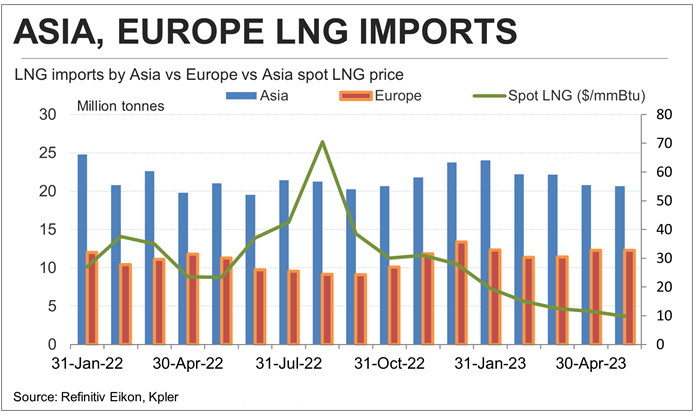
However, European gas prices continued to fall even throughout mild winter weather as a result of high storage levels, with May TTF front-month averaging at 10,11 USD/MMBtu, 25% lower m-o-m. European storage levels stood at 62 Bcm at the end of April 2023, 80% up on the levels one year earlier, and well above the five-year average of 40 Bcm.
Asian industrial demand has not been back yet and the absence of significant supply shocks has dragged Asian LNG prices down to $9.882/MMBtu (June delivery, assesed on May 5 by Platts), considered the lowest for the past two years. China's spot demand for LNG has been below expectations as the country decided to resume utilizing coal and renewable energy to meet its requirements. Downstream trucked LNG prices, which provide a significant source of demand for imported LNG, have also been lower than spot LNG prices. Japan, Korea and India still have ample supply to meet weak domestic demand.
Global LNG market is expected to reach a balance between 2026 and 2027 with a wave of new liquefaction projects to come online. North American gas exports are expected to reach 135.8 bcm in 2023, 14% higher y-o-y. In the US, an additional 104 MMtpa of export capacity is in various stages of development. Mexico will soon become a net LNG exporter, with FLNG Altamira on the Gulf Coast starting exports toward the end of 2023.
A super-chilled solution for the country’s energy demand
Resolution No. 55-NQ/TW of the Politburo on orientations of Vietnam's national energy development strategy to 2030, with a vision to 2045 has set out some key goals: “To firmly ensure security national energy and provide adequate, stable, high-quality energy at reasonable prices for fast and sustainable socio-economic development to eventually ensure national defense and security, improve people's living standards and contribute to the protection of the ecological environment”, “To efficiently and economically ultilize domestic energy resources in combination with rational energy exportation and importation” and “ To domestically produce key equipment in the energy sector and implement advanced and modern electricity transmission and distribution grids”. In line with that Prime Minister Pham Minh Chinh's commitment at COP26 to achieve net zero emissions by 2050 has clearly shaped the problem of LNG energy development in the future.